.png)
Beyond PRP: What Is Photothermal Biomodulation and Why It Changes the Regenerative Game [MCT PRP Therapy]
Updated: Jun 25
Platelet-rich plasma has been a mainstay of regenerative esthetics for over two decades. Australian and New Zealand clinics have adopted it widely — for skin rejuvenation, hair restoration, and a growing range of dermatological applications. The evidence base is solid, the safety profile is well established, and the autologous nature of the treatment aligns with patient demand for biologics over synthetics.
But PRP has a well-documented ceiling. Growth factors degrade rapidly. Preparation protocols vary from clinic to clinic. Chemical activators carry immunogenic risks. Outcomes can be inconsistent, and maintenance sessions are often needed sooner than practitioners would like.
The question forward-thinking clinicians are now asking isn't whether PRP works — it's whether PRP alone is still enough.
MCT Meta Cell Technology represents the next evolution. By applying photothermal biomodulation to autologous samples before injection, MCT enhances the biological activity of PRP at a cellular level — producing more exosomes, more growth factors, and more consistent results. For clinics looking to differentiate their regenerative offering, understanding this technology is no longer optional.
"The question forward-thinking clinicians are now asking isn't whether PRP works — it's whether PRP alone is still enough."

The Limitations of Conventional PRP
Conventional PRP therapy draws on the patient's own blood, concentrates the platelet fraction through centrifugation, and injects it into target tissue. It is safe, relatively straightforward to perform, and backed by meaningful clinical evidence across multiple indications.
Yet its limitations are increasingly well documented. A 2025 systematic review published in Skin Health and Disease (Oxford University Press) identified several consistent challenges across the PRP literature:

These are not reasons to abandon PRP. They are reasons to enhance it.
What Is Photothermal Biomodulation?
Photothermal biomodulation (PBM) is the application of controlled light energy and temperature to modulate biological activity at the cellular level. It is not a new concept in medicine — photobiomodulation has been studied extensively across wound healing, musculoskeletal conditions, and cell biology. What is new is its application to autologous blood products prior to injection.
At its core, PBM works by interacting with mitochondrial chromophores — light-sensitive proteins within cells that trigger downstream biochemical cascades when stimulated. The result is an increase in adenosine triphosphate (ATP) production, enhanced cellular metabolism, and — crucially — greater secretion of growth factors and extracellular vesicles, including exosomes.
Thermal biomodulation (TBM) operates through a complementary mechanism. Temperature modulates enzyme activity, platelet kinetics, and cellular transport. Research has established that cold temperatures (around 4°C) can enhance platelet performance and the release of key growth factors — including VEGF, EGF, and bFGF — from PRP samples. When light and temperature are applied together simultaneously, with precise control, the effects compound. This is the fundamental principle behind MCT.
"When light and temperature are applied together — simultaneously and with precise control — the effects compound. This is the fundamental principle behind MCT."
How MCT Delivers Photothermal Conditioning
MCT Meta Cell Technology is a CE-marked and FDA-cleared Class IIa medical device developed to bring photothermal biomodulation to the clinical setting in a standardised, reproducible format. It consists of two components:

In a standard PRP protocol, the patient's blood is drawn, centrifuged to concentrate the platelet fraction, then loaded into the MCT Kit and inserted into the MCT Unit. For approximately 10 minutes, the sample is simultaneously exposed to a specific light wavelength (commonly 620–623 nm for PRP applications) and maintained at 4°C. The result is a photothermal-conditioned PRP administered via standard mesotherapy microinjection technique — no change to the injection workflow, no additional consumables beyond the sterile MCT Kit, and no exogenous chemical activators.
What the Published Evidence Shows
Photothermal conditioning of PRP is an emerging field, and the evidence base — while promising — continues to develop. Most current studies are pilot-scale, or case series, and larger randomised controlled trials are ongoing. With that context clearly stated, the published data to date are encouraging across three domains.
Growth Factor Enhancement
A peer-reviewed ex vivo study (n=16 patients) assessed growth factor concentrations in PRP samples before and after thermal conditioning at 4°C for 10 minutes using the MCT system. The findings showed statistically significant increases in three key growth factors (the study used semi-quantitative analysis and involved a short conditioning time — noted as limitations by the authors):

PDGF (platelet-derived growth factor) showed no statistically significant change in this study. A separate experimental study (n=40) comparing thermally activated PRP against conventional PRP with no activator found significantly higher PDGF and VEGF levels in the thermally activated group.
Exosome Production
The 2025 review published in Skin Health and Disease (Ardic & Ardic, Oxford University Press) summarised comparative data between conventional and photothermal-conditioned PRP. Emerging data from the reviewed literature suggest that photothermal conditioning may lead to a two- to threefold increase in growth factor levels and up to a fivefold increase in exosome production compared to conventional PRP preparations. The authors note these trends require confirmation in larger studies.
Exosomes are the key vehicle for MCT's regenerative effects — extracellular vesicles that carry microRNAs, proteins, and growth factor signals between cells. Greater exosome yield means more robust cell-to-cell communication and more sustained regenerative signalling at the treatment site.
Clinical Outcomes
A prospective, multicenter, open-label pilot study (n=45, all patients with prior PRP treatment experience) evaluated photothermal-bioactivated PRP for facial rejuvenation versus their previous standard PRP sessions. Patients most frequently cited increased skin radiance and brightness (27.4%) as the most noticeable change, followed by better overall appearance (16.4%) and smoother skin texture (15.1%). Complication rates were negligible.
A separate prospective pilot study (n=10) used high-frequency ultrasonography (HF-USG) to compare MCT Plasma against standard PRP for hand rejuvenation, measuring skin subepidermal band width objectively. MCT Plasma patients reported superior subjective satisfaction and greater perceived skin improvement compared to the standard PRP control hand.
Conventional PRP vs. MCT Photothermal PRP: At a Glance
The following comparison is drawn from data presented in the Skin Health and Disease 2025 systematic review (Ardic & Ardic) and related published clinical literature.
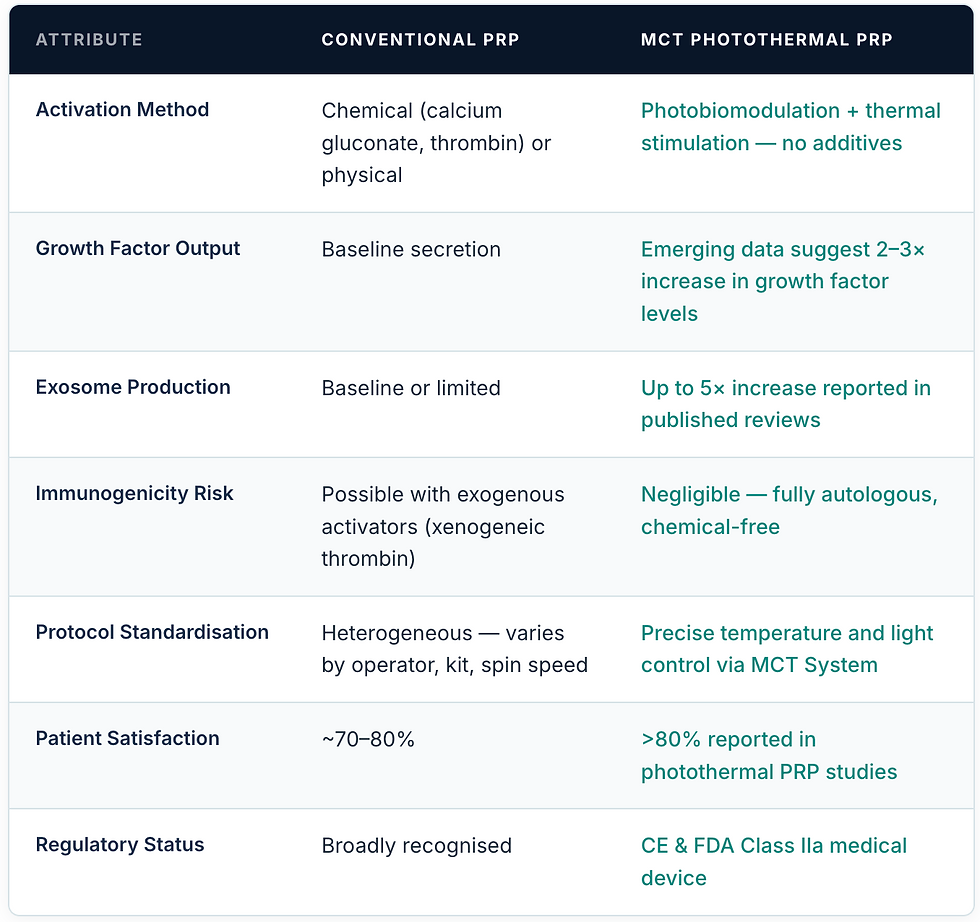
Sources: Ardic IN & Ardic N. Skin Health and Disease, Oxford University Press, 2025; and associated published clinical literature.
MCT Enhances PRP Therapy

Conclusion
The science underpinning photothermal biomodulation is rigorous and growing. For aesthetic clinicians who have built their regenerative practice on PRP, MCT Meta Cell Technology represents a meaningful, evidence-informed upgrade — not a departure from autologous medicine, but a deepening of it.
MCT is currently available in Australia exclusively through Athena BioMed.

References
Ardic IN & Ardic N. Photothermal conditioning of platelet-rich plasma: mechanisms and emerging applications in hair regeneration. Skin Health and Disease, Oxford University Press. Published online 22 December 2025. https://doi.org/10.1093/skinhd/vzaf089
Pinto H et al. Efficacy and safety of photothermal-bioactivated platelet-rich plasma for facial rejuvenation. Journal of Cosmetic Dermatology. 2023;22:671–673. DOI: 10.1111/jocd.15250
Pinto H et al. MCT Plasma vs Standard PRP for Hand Rejuvenation. Prospective randomised pilot study, TClinic Toledo, 2022–2023.
Pinto H et al. The Effect of Thermal Conditioning on Growth Factors in PRP. PRIME Journal, May/June 2020.
MCT Meta Cell Technology. Product documentation and clinical case library. Athena BioMed, 2024.


