.png)
Not All PDO Threads Are Created Equal: How MINT PDO Threads Stand Out
Updated: Jun 15
Thread lifting has matured from a fringe technique into a central pillar of minimally invasive facial rejuvenation. Global adoption has accelerated sharply, driven by patient demand for natural-looking outcomes without surgical downtime — and by a new generation of aesthetic physicians who understand that structural support and biostimulation are not mutually exclusive goals.
Yet with growth comes proliferation. The PDO thread market now hosts an expanding field of manufacturers, each claiming superiority in lift, longevity, and safety. For the discerning clinician, this creates a meaningful challenge: how do you distinguish engineering excellence from marketing noise?
The answer lies not in brand positioning, but in the details that most product literature glosses over — barb geometry, absorption kinetics, regulatory standing, shelf-life integrity, and the clinical evidence that either validates or undermines each claim.
"In thread lifting, the difference between a satisfying outcome and an adverse event is often a matter of millimeters — in barb depth, insertion angle, and the mechanical consistency of the thread itself."
This article offers a rigorous, evidence-informed comparison across the attributes that matter most to practitioners and their patients and examines why MINT Lift PDO Threads have emerged as the reference standard against which other platforms are increasingly measured.
Regulatory Standing: The First Filter
Before evaluating design or clinical performance, regulatory clearance is the baseline. In an era of increasing scrutiny from both patients and medical boards, practitioners carry professional risk when deploying devices that lack rigorous safety validation.
MINT Lift PDO Threads hold three separate FDA clearances, a distinction that remains exceptionally rare in the global thread market.
Many competing products carry only CE marking — which, while meaningful within European regulatory frameworks, does not require the same level of clinical evidence submission. Several widely marketed thread brands in the Asia-Pacific and Southeast Asian markets lack formal regulatory clearance for aesthetic facial suspension.
For clinicians practising in markets with increasing regulatory oversight, or those treating patients who specifically inquire about device safety credentials, triple FDA clearance is not merely a marketing asset — it is a clinical and medicolegal foundation.
Barb Engineering: Where Lift Actually Comes From
The lifting force of any barbed PDO thread is entirely a function of its anchorage mechanism. MINT Lift PDO Threads feature a patented 360° helical barb pattern with 55 molded cogs distributed continuously along the thread's working length — a design that creates uniform tissue grip rather than relying on discrete fixation points.
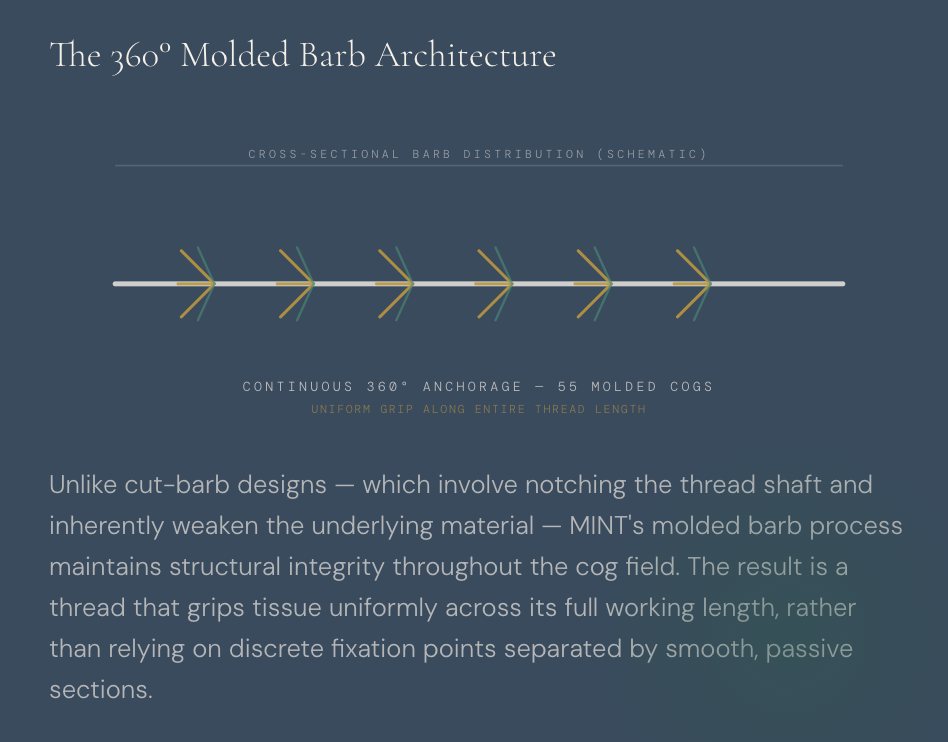
Competing architectures — whether discrete PLLA/PLGA cones or cut-barb PDO — concentrate lift at isolated points with passive, unengaged sections between them. The clinical consequence is a less uniform lift vector and earlier mechanical fatigue, as those focal anchors bear disproportionate load over time.
A Clinical Comparison Across Key Parameters

Absorption Kinetics and Complication Risk

Slower-absorbing materials — PLLA/PLGA and certain polycaprolactone composites — persist as foreign material for up to 24 months. In high-mobility zones or when placement is marginally superficial, this prolongs the window for palpable stiffness, nodule formation, and granulomatous reaction.
PDO's shorter absorption cycle resolves these risks within a clinically manageable timeframe. Critically, the regenerative benefit continues beyond the material's physical lifespan — neocollagenesis, triggered by the controlled foreign body response, actively remodels tissue architecture for over a year after complete absorption.
Shelf Life — A Frequently Overlooked Variable
Several distributed thread brands label a 12-month expiry, yet practitioner reports and material data indicate significant mechanical degradation well before that window closes. MINT Lift PDO Threads are validated to maintain full barb holding strength through a three-year shelf life — reducing both clinical risk and inventory waste for busy practices
Procedure Precision and Patient Recovery
Lift outcome and complication avoidance are equally shaped by insertion system quality. MINT Lift PDO Threads are supplied pre-loaded into smooth cannulas or needles — enabling single-pass insertion with minimal tissue displacement, reduced bruising, and faster patient recovery.
Platforms requiring multi-step anchoring or cone placement via separate passes introduce compounding variables: additional tissue trauma, greater post-procedural oedema, and extended downtime. For a patient demographic that increasingly expects same-week social presentability, recovery experience is part of the clinical value proposition.
"The best procedural system reduces operator variability, not just tissue trauma. Consistency at scale is what separates a reliable thread protocol from an unpredictable one."
MINT's broad product range — spanning multiple gauges, lengths, and barb configurations — further enables genuine customisation across the brow, midface, jawline, neck, and selected body applications, from a single cohesive platform with consistent handling properties throughout.
Precision Is the Differentiator
In a crowded thread market, the meaningful distinctions are engineering-level, not cosmetic. Barb geometry, absorption kinetics, regulatory standing, and shelf-life integrity are not marketing attributes — they are the variables that determine outcomes, complication rates, and long-term patient satisfaction.
MINT Lift PDO Threads represent, across each of these parameters, the current benchmark in the category — backed by triple FDA clearance, over a dozen clinical submissions, and a decade of iterative design refinement.
It is the first and only thread of its kind to have three FDA clearances for :
skin approximation
nasolabial fold depth reduction
facial suspension


